
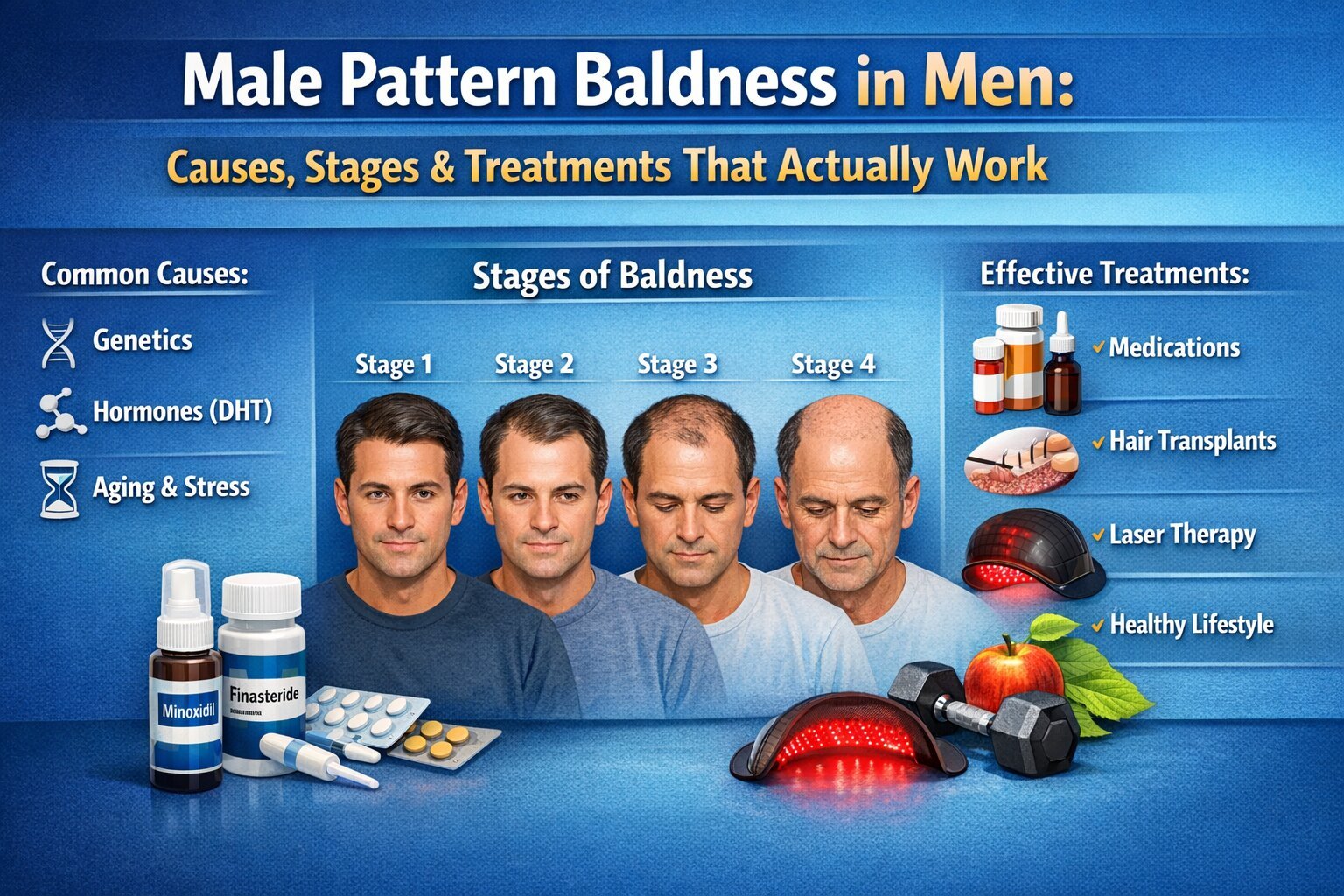
Hair loss is one of the most common concerns among men, yet it is often misunderstood, ignored, or treated too late. Male pattern baldness, medically known as androgenetic alopecia, affects millions of men worldwide and can begin as early as the late teens or early twenties. Understanding its causes, progression, and scientifically proven treatments can help men take timely action and avoid permanent hair loss.
If you are noticing a receding hairline, thinning crown, or excessive hair shedding, this guide explains everything you need to know about Male Pattern Baldness in Men: Causes, Stages & Treatments That Actually Work-based on medical research and clinical experience.
What Is Male Pattern Baldness?
Male pattern baldness is a genetic and hormone-driven condition that causes progressive thinning of scalp hair in a predictable pattern. It typically starts at the temples or crown and gradually spreads, leading to partial or complete baldness over time.
The condition is caused by sensitivity of hair follicles to dihydrotestosterone (DHT), a hormone derived from testosterone. Over time, DHT shrinks hair follicles, making hair thinner, shorter, and eventually unable to grow.
Male pattern baldness is not a disease or a contagious condition-it is a hereditary trait passed down through family genetics.
Common Causes of Male Pattern Baldness
1. Genetics
The primary cause of male pattern baldness is genetic inheritance. If your father, grandfather, or maternal relatives experienced early hair loss, your chances of developing the condition are significantly higher.
2. Hormonal Changes
DHT plays a central role in male pattern hair loss. Men who are genetically sensitive to this hormone experience gradual miniaturization of hair follicles, which leads to thinning hair and eventually baldness.
3. Ageing
Hair thinning is progressive and becomes more noticeable with age. By the age of 50, nearly half of men experience some degree of male pattern baldness.
4. Lifestyle and Health Factors
Although genetics and hormones are the main triggers, stress, poor nutrition, smoking, and chronic illnesses can accelerate hair loss and worsen its appearance.
Stages of Male Pattern Baldness
Hair loss does not occur overnight. It progresses gradually through well-defined stages, commonly classified using the Norwood Scale.
Stage 1: Normal Hairline
There is no noticeable hair loss. The hairline is intact, and hair density remains consistent across the scalp.
Stage 2: Mature Hairline
A slight recession appears at the temples. Many men mistake this stage for normal ageing rather than early baldness.
Stage 3: Visible Recession
This is the stage where male pattern baldness becomes clinically noticeable. The hairline forms an “M” shape, and thinning may begin at the crown.
Stage 4-5: Crown Thinning and Hairline Loss
Hair loss becomes more pronounced, and the bald spot at the crown expands. The hairline and crown may still be separated by a thin bridge of hair.
Stage 6-7: Advanced Baldness
At this stage, most of the top of the scalp becomes bald, leaving hair only on the sides and back of the head.
Recognizing early stages is critical because treatments are most effective before hair follicles become permanently inactive.
Treatments That Actually Work
There are countless shampoos, oils, and supplements marketed as miracle cures for hair loss. However, only a few treatments are backed by strong clinical evidence.
1. Minoxidil: The First-Line Treatment
Minoxidil is a topical medication that increases blood flow to hair follicles and prolongs the hair growth cycle. It helps slow hair loss and stimulates regrowth in many men when used consistently.
Clinical studies show that minoxidil can significantly improve hair density and thickness in men with androgenetic alopecia.
2. Finasteride: Blocking the Root Cause
Finasteride is an oral medication that works by inhibiting the conversion of testosterone into DHT, directly targeting the hormone responsible for follicle shrinkage.
Long-term clinical trials have demonstrated that daily finasteride use improves hair growth and prevents further hair loss in a majority of men.
3. Combination Therapy
Recent clinical research suggests that combining finasteride and minoxidil produces better results than using either treatment alone, as one blocks DHT while the other stimulates follicle activity.
4. Low-Dose Oral Minoxidil
In recent years, dermatologists have also started prescribing low-dose oral minoxidil for patients who do not respond to topical treatments. Emerging studies indicate it may be a safe and effective option under medical supervision.
When Hair Transplant Becomes the Best Option
Medications can slow or reverse early hair loss, but they cannot restore hair in areas where follicles are completely destroyed. In advanced stages, hair transplant surgery becomes the most effective and permanent solution.
Modern techniques such as FUE (Follicular Unit Extraction) and DHI (Direct Hair Implantation) offer natural-looking results with minimal downtime.
However, choosing the right surgeon and clinic is critical. A poorly performed transplant can lead to unnatural hairlines, scarring, or graft failure.
Why Expert Guidance Matters Before Choosing a Hair Transplant
Many men rush into hair transplant surgery after seeing online advertisements, without understanding whether they are suitable candidates or which doctor is truly experienced. This is where platforms like Tricho Talk play a valuable role.
Tricho Talk works like a casting platform that suggests the best doctor to someone who needs a hair transplant. Instead of randomly selecting a clinic, users can receive personalized recommendations based on their hair loss stage, budget, and treatment goals. This helps patients connect with qualified specialists and avoid unverified clinics.
Such guided selection improves treatment outcomes and ensures that patients make informed decisions rather than emotional ones.
Myths About Male Pattern Baldness
Myth 1: Wearing caps causes hair loss
There is no scientific evidence that wearing hats or helmets causes male pattern baldness. The condition is driven by genetics and hormones.
Myth 2: Hair oils can reverse baldness
While oils can improve scalp health and reduce dryness, they cannot stop DHT-related follicle shrinkage or regrow hair in balding areas.
Myth 3: Shaving your head makes hair grow thicker
Hair thickness is determined by follicle size, not by shaving frequency.
Psychological Impact of Hair Loss in Men
Hair loss is often dismissed as a cosmetic issue, but its emotional impact can be significant. Studies show that early baldness is associated with reduced self-confidence, social anxiety, and body image concerns.
Men who address hair loss early-through medication, lifestyle changes, or surgical options-tend to report higher satisfaction and better mental well-being.
How to Prevent or Slow Down Hair Loss
Although male pattern baldness cannot be completely prevented, its progression can often be slowed with early intervention.
Healthy lifestyle habits such as a balanced diet rich in protein, iron, and vitamins, stress management, and regular scalp care can support overall hair health. However, medical treatments remain the only proven way to stop hormone-driven hair loss.
Male pattern baldness is a progressive condition, but it is no longer an untreatable one. With modern medical therapies, advanced hair transplant techniques, and expert consultation platforms like Tricho Talk, men today have more options than ever to restore their hair and confidence.
The key is early diagnosis, evidence-based treatment, and guidance from qualified professionals. Ignoring early signs or relying on unproven remedies often leads to irreversible hair loss, making treatment more complex and expensive later.
If you are experiencing thinning hair or a receding hairline, consulting a hair specialist at the right time can make the difference between temporary thinning and permanent baldness.
Leave a reply